




Last Updated on 03/11/2026 by Dr Chetan Kaher
If you are searching “crowns near me” because a tooth is cracked, heavily filled, worn, or damaged by decay, a crown isn’t always the only option.
In some cases, an onlay can do the job with less impact on the tooth itself. Both restorations protect a damaged tooth, but they are built for different levels of damage, and knowing the difference before your appointment helps you understand why your dentist recommends one over the other.
What actually separates a crown from an onlay
A crown covers the entire visible portion of a tooth, essentially capping it completely. An onlay is more conservative, covering only the damaged section, often one or more cusps, while leaving healthy surrounding tooth structure untouched. The distinction matters because removing a healthy tooth to fit a crown isn’t reversible, so dentists generally prefer the more conservative option whenever the tooth’s condition genuinely allows for it.
Crown vs onlay, side by side
| Factor | Dental Crown | Dental Onlay |
|---|---|---|
| Coverage | Entire visible tooth | Damaged area and affected cusps only |
| Tooth preparation | More extensive | More conservative, preserves more natural tooth |
| Best suited for | Severely weakened or extensively damaged teeth | Moderate damage with enough healthy structure remaining |
| Typical lifespan | 15+ years with proper care | Similarly long-lasting, depends on remaining tooth health |
| Starting cost at Smile Cliniq | From £500 (porcelain bonded to non-precious metal) | Assessed individually based on material and extent |
Why “more coverage” isn’t automatically the safer choice
It is tempting to assume that covering more of the tooth is inherently more protective. In practice, the opposite logic often applies. If an onlay can achieve the same repair while preserving more of your natural tooth, it is usually the better long-term choice, not a lesser one. Full coverage becomes necessary specifically when there isn’t enough healthy structure left to support anything less.
When a crown is genuinely the better fit
Crowns tend to be recommended when:
- The tooth has extensive decay or a large existing filling that’s compromised most of its structure.
- There is a real risk of fracture under normal biting pressure without full coverage.
- The tooth has already had root canal treatment, which typically leaves it more brittle, since it has lost its blood supply and some structural resilience along with it, meaning it needs full protection against everyday chewing forces.
- Damage extends around most sides of the tooth rather than being confined to one surface.
- An existing crown has become defective and needs full replacement.
When an onlay is the more sensible choice
Onlays tend to work well when:
- Damage or decay is limited to the biting surface or one section of the tooth.
- Enough healthy tooth structure remains that full coverage would remove more than necessary.
- A large filling has weakened part of the tooth without compromising the whole structure.
What it actually costs at Smile Cliniq
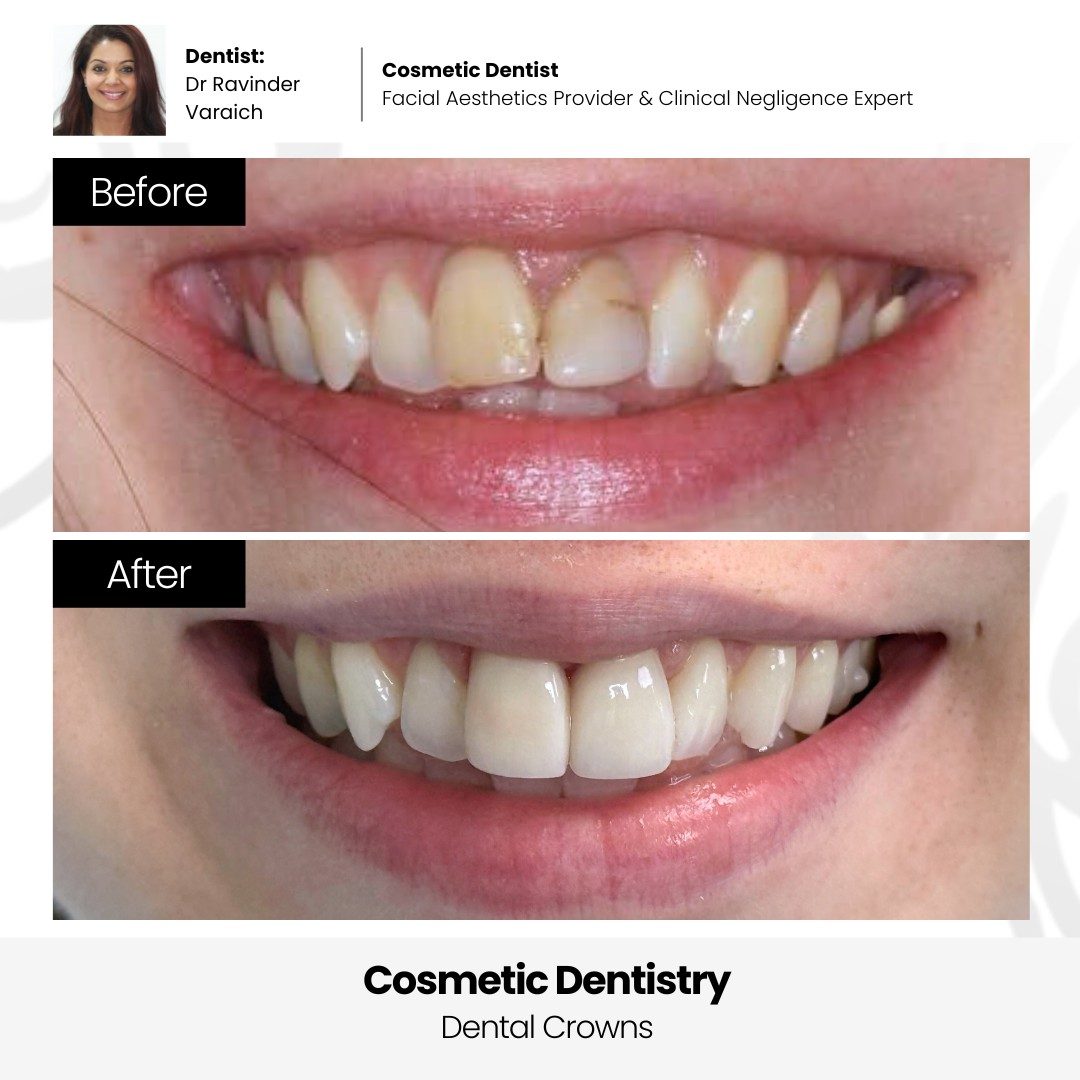
Crown pricing depends on material. Porcelain bonded to non-precious metal starts from £500, porcelain bonded to precious metal from £650, Gradia from £550, Emax (all-porcelain) from £750, and zirconia or gold crowns from £850. Bridges start from £450 per crown unit, and recementing an existing crown or bridge, if one comes loose, costs £80 or £120 respectively. All crown and bridge treatments carry a 15% membership discount, and Smile Cliniq offers a 0% finance calculator for spreading the cost. Onlay pricing varies similarly by material and is assessed individually, since it depends on the extent of the damaged area being restored.
Choosing an onlay isn’t automatically the cheaper route, it depends on the material used and the complexity of the case. The more important question is always which restoration actually suits the tooth, not which one costs less on paper.
How long each one actually lasts
Smile Cliniq expects its crowns to last more than 15 years with proper care, backed by a five-year guarantee against crown fracture, subject to standard terms and exclusions. Onlays can last comparably long, but their lifespan depends heavily on the same factors that affect any restoration: oral hygiene, biting forces, tooth position, the material chosen, and habits like teeth grinding. There is no single number that applies to every patient regardless of restoration type, what matters most is whether the option chosen matched what the tooth genuinely needed.
Finding the right fit close to home
For anyone searching for “crowns near me” in north London, our ceramist Kevin Vara works closely with the clinical team on every crown and onlay made at Smile Cliniq’s Finchley and St John’s Wood practices, starting with an examination, including photographs, scans, and X-rays where needed, before recommending a restoration. This means the choice between a crown and an onlay is based on the specific condition of your tooth, not a default assumption either way.
The bottom line
The right choice isn’t about which restoration sounds more robust or which carries the lower price tag. It is about matching the treatment to how much healthy tooth structure remains and how much protection that specific tooth needs, which is exactly why a proper assessment, not a guess based on symptoms or cost alone, should guide the decision.
One reason this choice gets made carefully here is that Kevin Vara, the practice’s own ceramist, is the person who will actually make the restoration, so the conversation about material and coverage happens with the lab in the room rather than at the end of a courier run. Both Finchley and St John’s Wood work the same way.
Smile Cliniq has two London practices: Finchley (138 Ballards Lane, Finchley, London N3 2PA, 020 8343 1133) and St John’s Wood (102 Boundary Road, London NW8 0RH, 020 7328 1200).
Frequently asked questions
Is an onlay just a smaller, cheaper version of a crown?
Not exactly. It is a different approach suited to less extensive damage, not simply a budget alternative. Pricing depends on material and complexity in both cases, so it is not a guaranteed cost-saver.
Can an onlay be upgraded to a crown later if needed?
Yes. If a tooth with an onlay develops further damage over time, it can be reassessed and treated with a crown at that point, without this being considered a failure of the original treatment.
Why do teeth need a crown after root canal treatment specifically?
Root canal treatment removes the nerve and blood supply from inside the tooth, which can leave it more brittle over time. A crown provides full coverage to protect against fracture under normal biting pressure.
How do I know which one my tooth actually needs?
This depends on the extent of damage and how much healthy tooth structure remains, which is best assessed directly through an examination rather than guessed based on symptoms alone.