



Last Updated on 17/09/2026 by Dr Chetan Kaher
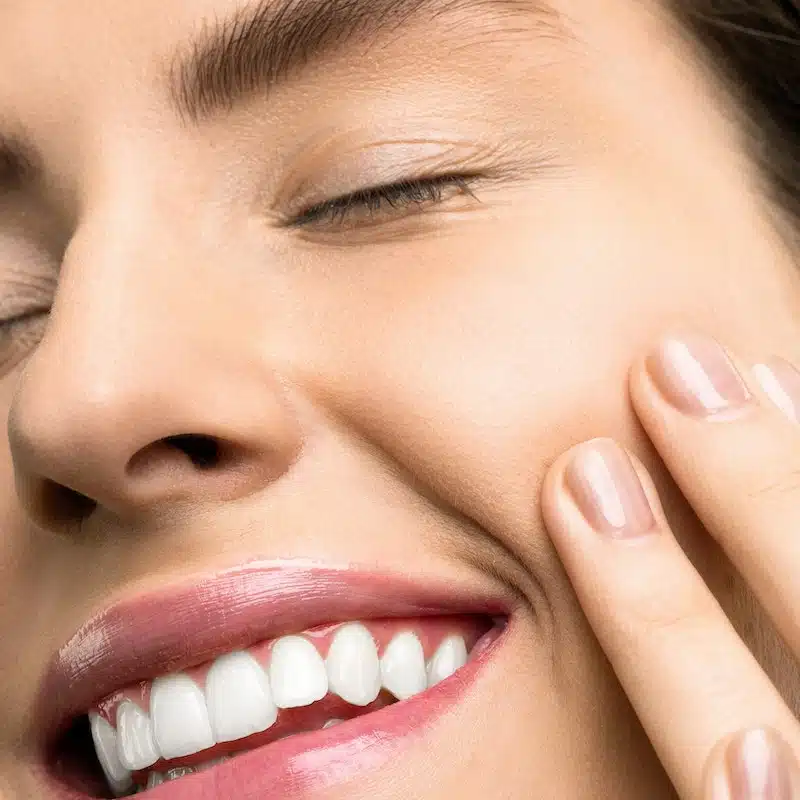
You’ve probably seen the app, or something like it, at a dentist’s website or an Instagram ad. Upload a photo of your smile, wait a few seconds, and it shows you what your teeth could look like with veneers or bonding.
It’s genuinely satisfying to watch, and it’s become one of the more common tools you’ll find when researching a cosmetic dentist London-wide. But there’s a gap between what that simulation shows you and what actually happens once real dental materials, real gum tissue, and real bite mechanics get involved. If you’re weighing up cosmetic work and you’ve already played with one of these previews, it’s worth knowing exactly where to trust it and where to take it with a pinch of salt.
How the simulation actually works
Most AI smile tools work by scanning your existing tooth shape and colour from a photo, then digitally overlaying a “corrected” version: straighter edges, whiter shade, more even spacing. It’s essentially a very sophisticated filter, built on thousands of reference smiles rather than anything specific to your mouth. That’s an important distinction, because it means the software is predicting what looks aesthetically balanced in general, not what’s achievable given your actual dentition, gum line, or bite.
What it gets right
To its credit, the simulation is genuinely useful for a few things. It gives you a starting point for conversation, rather than trying to describe what you want in words, which most people find surprisingly hard to do. It’s also useful at showing colour and shape changes in a way that’s easy to react to. If a preview makes your teeth look too uniform, too white, or oddly square, that’s useful feedback before you’ve spent a penny. Any cosmetic dentistry London practice worth its salt will use that reaction as a starting point, not a final decision.
It’s also fairly reliable for showing symmetry corrections, closing small gaps and evening out chip damage, because those are largely surface-level, cosmetic changes that don’t depend heavily on what’s happening beneath the gum line.
Where it quietly gets things wrong
Here’s what most simulations don’t account for. Your enamel has a natural limit to how much it can be reshaped before it weakens the tooth. A simulation doesn’t know your enamel thickness. It’s working off a photo, not a scan of your actual tooth structure, so it can show you a result that would require removing more enamel than is sensible, without ever flagging that trade-off.
It also doesn’t know your gum health. If your gums are uneven, or there’s a mild recession that isn’t obvious in a casual photo, that affects how veneers or bonding will actually sit and look once placed. The software smooths over all of that because it’s simply not designed to detect it.
Bite is the other big blind spot. Veneers and bonding change how your teeth meet when you close your mouth, and if that’s not accounted for, you can end up with results that look great in photos but feel wrong every time you eat or speak. No simulation factors in your bite, because that’s not something you can assess from a single image.
Why this matters before you book anything
None of this means the simulation is pointless, it’s a helpful visual starting point. But treating it as a preview of your actual outcome, rather than a rough concept, is where people run into disappointment. We’ve had patients come in with a saved simulation image expecting an exact match, and had to explain that the version they’d fallen in love with wasn’t achievable without compromising their enamel or ignoring a bite issue the software had no way of seeing.
This is really the difference between browsing online and sitting down with an actual cosmetic dentist in London. A simulation shows you a possibility. A proper assessment tells you which parts of that possibility are realistic for your mouth specifically, and what would need to change about the plan to get you there safely.
What a real assessment adds that the app can’t
When you come to Smile Cliniq for cosmetic dentistry in London, the process usually starts with exactly the things a simulation skips. Our Invisalign and composite bonding provider Dr Nickil Dhokia looks at your enamel thickness to determine how much reshaping is sensible, checks your gum health because uneven or receding gums can affect how bonding or veneers sit, and assesses your bite to make sure the finished result works day-to-day, not just in a photo.
From there, the conversation becomes a lot more grounded. Instead of chasing a filtered image, you’re working from what’s realistic given your actual teeth, which tends to produce results people are happier with long-term, because there’s no gap between the preview and reality. AI smile simulations can be helpful for visualising the overall look of your new smile, but they don’t always show the full range of tooth shapes available. With composite bonding or veneers, we can tailor the shape to you, whether you prefer a softer, more rounded look, a more defined square shape, or something in between.
Is the AI simulation worth using?
Yes, as a starting point. It’s a good way to work out roughly what direction you want to go in before your first proper conversation. Just don’t treat it as a guarantee. The people searching for the best cosmetic dentist in London, UK are usually the ones who’ve already worked that out and are looking for someone who’ll tell them honestly what’s achievable rather than just recreating the filtered version of their smile.
If you’ve got a simulation saved on your phone and want to know how close it is to reality, that’s exactly the kind of thing worth bringing to a consultation. Smile Cliniq sees cosmetic patients at both Finchley (138 Ballards Lane, Finchley, London N3 2PA) and St John’s Wood (102 Boundary Road, London NW8 0RH).
Frequently asked questions
Can an AI smile simulator replace a dental consultation?
No. It’s a useful way to explore direction, but it can’t assess your actual enamel thickness, gum health or bite, which is what determines whether bonding, veneers or another treatment fits your case.
Why doesn’t my simulated smile match what my dentist recommends?
The app doesn’t know your enamel thickness, gum health or bite, so it can show results that would need more enamel removed than is sensible, or that would feel wrong when you bite down.
Should I bring an AI-generated smile photo to my consultation?
Yes, it’s a genuinely useful starting point for the conversation. Just treat it as a rough concept rather than a guaranteed outcome.

Related Blogs